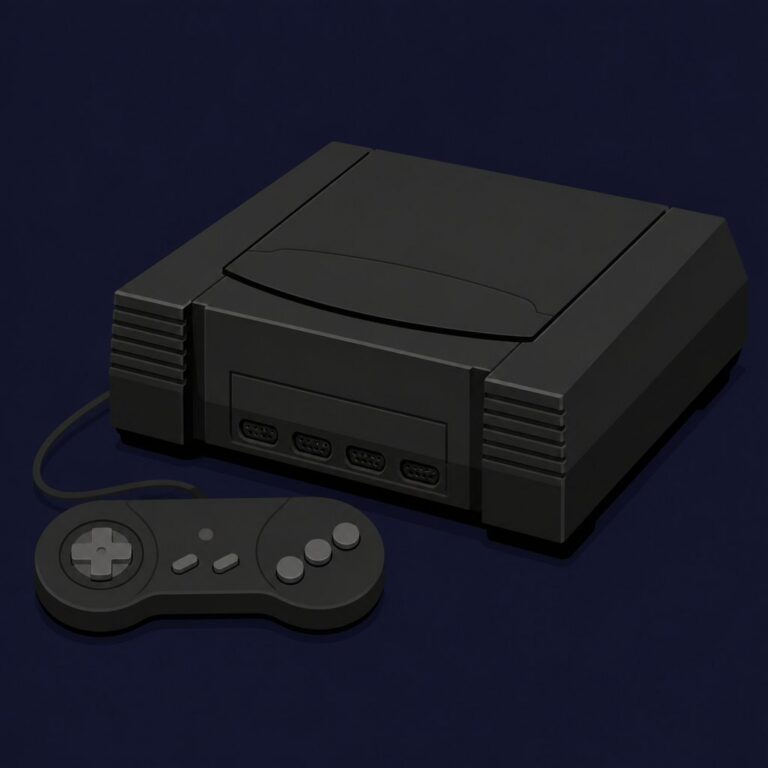
The 3DO Interactive Multiplayer is a fifth-generation console based on an open hardware format designed by The 3DO Company (founded by EA’s Trip Hawkins) and built under license by Panasonic, GoldStar and Sanyo. The first model, the Panasonic FZ-1, launched in North America on October 4, 1993, Japan on March 20, 1994, and Europe in June 1994.
The 3DO Interactive Multiplayer was the most ambitious console of the early 1990s — and one of the most expensive failures. Conceived by Trip Hawkins (founder of Electronic Arts) as an open-standard, multi-manufacturer platform that would do for gaming what VHS did for video, the 3DO launched at an astonishing $699.99 in October 1993. It had genuine technical merit, produced some impressive games, and pioneered the CD-ROM multimedia approach. But its price was fatal, and it was crushed by the PlayStation and Saturn within two years.
History & Development
Trip Hawkins founded The 3DO Company in 1991 with a radical business model: 3DO would design the hardware specification and license it to multiple manufacturers, who would compete on price and features — just like the VCR or DVD player market. Panasonic (Matsushita) was the primary launch partner, with Goldstar (later LG) and Sanyo producing their own models later.
The 3DO launched on October 4, 1993 in North America. Panasonic’s FZ-1 model was an attractive, top-loading disc player. The $700 price reflected Panasonic’s need to profit on hardware (since 3DO’s licensing fees were minimal) — a fundamental flaw in Hawkins’ model. Console manufacturers traditionally sold hardware at or below cost, making up the difference on software licensing. The 3DO model gave manufacturers no incentive to subsidize the hardware price.
Price drops followed — $499 by mid-1994, $399 by late 1994 — but the damage was done. When Sony’s PlayStation launched at $299 in 1995 with superior 3D graphics, the 3DO was effectively dead. The planned 3DO M2 successor was cancelled, and the 3DO Company transitioned to software development before filing for bankruptcy in 2003.
Hardware & Technical Specifications
The 3DO’s ARM60 RISC CPU at 12.5 MHz was complemented by two custom graphics co-processors for sprite scaling, rotation, and cel animation. The system excelled at 2D sprite manipulation and full-motion video but lacked dedicated 3D polygon hardware — a critical shortcoming as the industry shifted to 3D gaming. 2 MB of main RAM and 1 MB of VRAM were generous for 1993.
The double-speed CD-ROM drive enabled CD-quality audio, full-motion video, and large game worlds. The controller used a unique daisy-chain design — controllers connected to each other rather than to the console, allowing up to 8 players with a single controller port. This reduced manufacturing costs but meant every multiplayer session required running cables from controller to controller.
Game Library & Legacy
The 3DO’s 295 games were a mix of genuine quality and FMV shovelware. The highlights were impressive: Road Rash (the definitive version at the time), Need for Speed (which launched on 3DO), Star Control II, Return Fire, Gex, Super Street Fighter II Turbo, and Samurai Shodown. The Horde and Killing Time were solid exclusives.
The FMV games — Night Trap, Mad Dog McCree, Plumbers Don’t Wear Ties — represented the worst of early CD-ROM gaming. The 3DO became unfairly associated with these low-quality interactive movies, overshadowing its legitimate software strengths.
Collecting & Value Today
3DO consoles are moderately collectible. The Panasonic FZ-1 sells for $100-200 USD. The Goldstar model is generally cheaper. Games range from $10-30 for commons to $80-200+ for rare titles. D, Lucienne’s Quest, and Japanese imports command the highest prices. The CD-ROM drive is the primary reliability concern — laser assemblies weaken, and replacement drives are specific to each manufacturer’s model.
Frequently Asked Questions
Who made the 3DO?
The format was created by The 3DO Company, founded in 1991 by Trip Hawkins (EA's founder), which licensed the specification to Panasonic, GoldStar and Sanyo.
Why did the 3DO fail?
Its $699 launch price and a licensing model with no hardware subsidy made it too expensive; the $299 Sony PlayStation finished it off in 1995.
What was the 3DO's successor?
The 64-bit PowerPC-based Panasonic/3DO M2 — which was never released as a console.
What were the best 3DO games?
Gex (its best-seller at over a million copies), Road Rash, Star Control II, Myst, Alone in the Dark and The Need for Speed.
How much did the 3DO cost?
US $699.99 at the October 1993 North American launch, later cut toward roughly $499.
What generation was the 3DO?
The fifth, competing with the Sony PlayStation, Sega Saturn and Atari Jaguar.