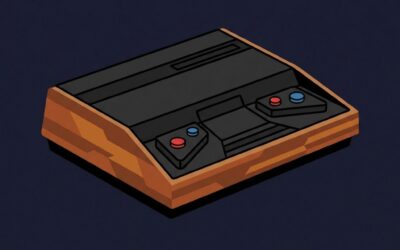

The Mattel Intellivision was the first serious challenger to Atari’s dominance. Launched in December 1979, it boasted a 16-bit processor (the first in a home console), superior graphics to the Atari 2600, and an aggressive marketing campaign that directly compared the two systems side by side. The Intellivision sold 3 million units and proved that the console market could support competition — a lesson the industry would learn and relearn across every generation since.
History & Development
Mattel Electronics, a division of the toy company, entered the video game market seeking to capitalize on the Atari 2600’s explosive success. The Intellivision (a portmanteau of “intelligent television”) was developed internally and test-marketed in Fresno, California in 1979 before a national rollout in 1980. It launched at $299 — significantly more expensive than the 2600’s $199 (which was already dropping toward $150).
Mattel’s marketing was confrontational. Television ads featuring spokesman George Plimpton placed Intellivision and Atari 2600 versions of the same games side by side, allowing viewers to see the Intellivision’s clearly superior graphics. “Intellivision is to Atari what Atari is to this,” Plimpton would say, pointing to a rubber ball — devastating comparison advertising that anticipated Sega’s “Genesis does what Nintendon’t” by a decade.
Mattel also made ambitious promises about an upcoming keyboard component that would transform the Intellivision into a full home computer. The keyboard was repeatedly delayed and eventually released in limited quantities as the Entertainment Computer System (ECS) in 1983. The Federal Trade Commission investigated Mattel for the delays, resulting in a $10,000 fine.
The Intellivision survived the early 1980s but could not weather the crash of 1983. Mattel Electronics reported losses of $394 million and shut down in 1984. The brand was sold to a former Mattel executive who continued selling the console as INTV Corporation until 1990, producing new games throughout the late 1980s.
Hardware & Technical Specifications
The Intellivision’s General Instrument CP1610 CPU was a genuine 16-bit processor — the first in any home console — running at 894.886 kHz. While the clock speed was low, the 16-bit data path allowed it to process more data per cycle than the 2600’s 8-bit MOS 6507. The General Instrument AY-3-8900-1 STIC (Standard Television Interface Chip) handled graphics, supporting a resolution of 159×96 pixels with 16 colors, 8 sprites, and sophisticated background tile capabilities.
The AY-3-8914 PSG provided 3 channels of sound plus a noise channel — a significant improvement over the Atari 2600’s 2-channel TIA audio. Music and sound effects on the Intellivision were notably richer and more melodic than 2600 titles.
The controllers were the Intellivision’s most distinctive and divisive feature. Each controller featured a 12-button numeric keypad, four side buttons, and a 16-direction disc (not a joystick or D-pad). Game-specific overlays slid into the controller, labeling the keypad buttons with context-specific functions. The disc was precise but uncomfortable for extended play — it sat flat against the controller face and required thumb pressure rather than the natural grip of a joystick. The controllers were hardwired to the console and could not be replaced without modification.
Game Library & Legacy
The Intellivision’s library of 125 games excelled in sports and strategy. Major League Baseball (the pack-in game for most of the console’s life) was the most popular title and arguably the best sports game available on any platform in the early 1980s. NFL Football, NBA Basketball, NHL Hockey, and Soccer all featured overhead perspectives and strategic depth that the 2600 couldn’t match. NASL Soccer and World Championship Baseball were highlights.
Beyond sports, Advanced Dungeons & Dragons: Treasure of Tarmin was a first-person dungeon crawler impressive for its era. Astrosmash was an addictive arcade-style shooter. Utopia (1982) is sometimes cited as the first simulation/strategy game — a two-player island management game that predated SimCity by seven years. BurgerTime was an excellent arcade port. Tron: Deadly Discs and Tron: Solar Sailer used the disc controller effectively.
The Intellivision also spawned the Intellivision II (a cost-reduced redesign) and the Intellivision III / INTV System III (further revisions under INTV Corporation). A modern revival — the Intellivision Amico — was announced in 2018 but faced years of delays and controversy, never achieving a successful retail launch.
Collecting & Value Today
The Intellivision is affordable to collect. Working consoles sell for $30-70 USD. Most games are in the $3-15 range — one of the cheapest retro libraries to complete. Rare titles include Spiker! Super Pro Volleyball (the rarest official release, $200-500+), World Championship Baseball, and several late INTV Corporation releases. The controller overlays are essential for full enjoyment and can be difficult to find separately. The hardwired controllers can develop dead spots on the disc — replacement is possible but requires soldering. Overall, the Intellivision offers excellent value for collectors interested in early console history.